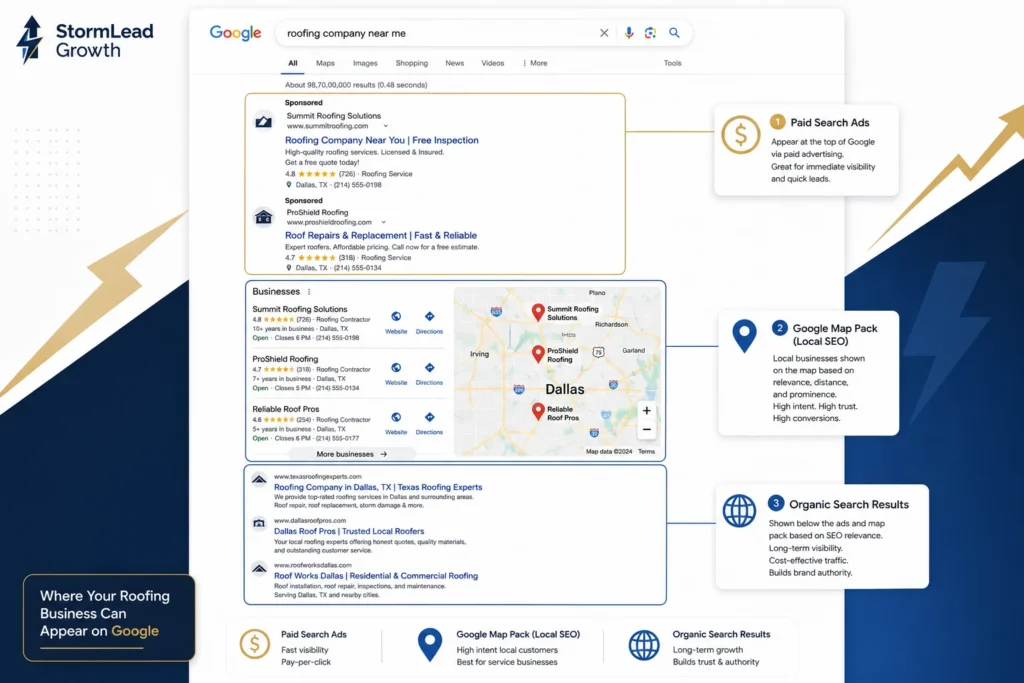
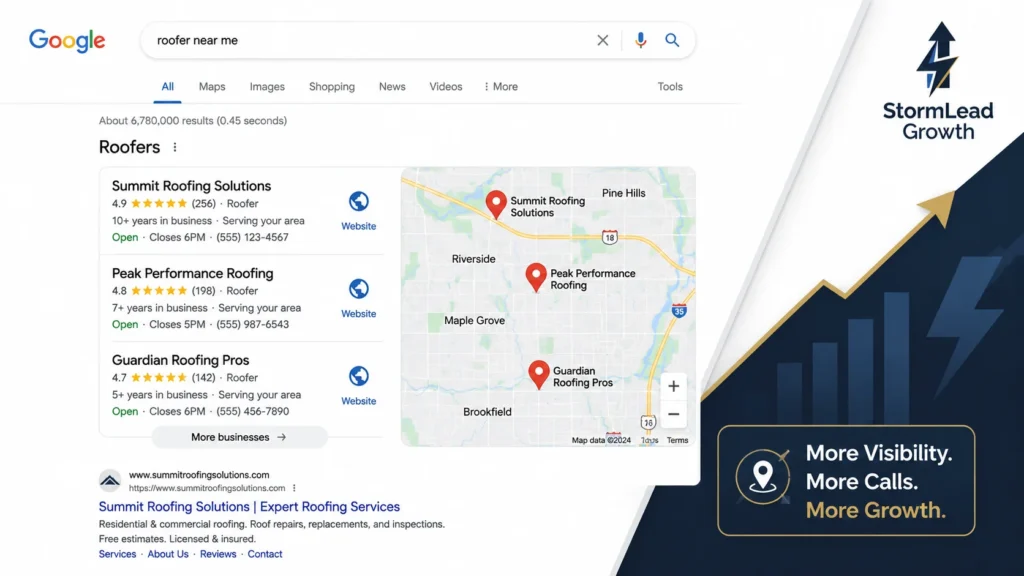
When a homeowner searches “roofer near me” on their phone, the first thing they see — after any ads — is the Google Map Pack. That’s the section showing three businesses on a map with their name, star rating, phone number, and hours.
Most homeowners pick one of those three businesses. They don’t scroll further. They don’t go to page two. They call someone from the map.
If your roofing company isn’t showing up in that Map Pack, you’re losing calls every single day to competitors who are. The good news is that Google Maps SEO for roofers isn’t complicated. It takes work, but it’s not a mystery. Here’s exactly what to do.
What Is the Google Map Pack and Why Does It Matter?
The Map Pack (also called the Local Pack or the 3-Pack) is the box of three local business listings that Google shows for local searches. It appears above the regular website results and includes a small map, business names, star ratings, review counts, addresses, phone numbers, and hours.
For roofing companies, the Map Pack is where the calls come from. A homeowner with a leaking roof isn’t browsing websites. They’re looking at the map, checking ratings, and calling the first business that looks trustworthy.
Ranking in the Map Pack is different from ranking in regular search results. It’s based primarily on three things: how close your business is to the searcher, how relevant your profile is to what they searched, and how strong your online presence is compared to other roofers nearby. You can’t control the first one, but you can control the other two.
Step 1: Claim and Complete Your Google Business Profile
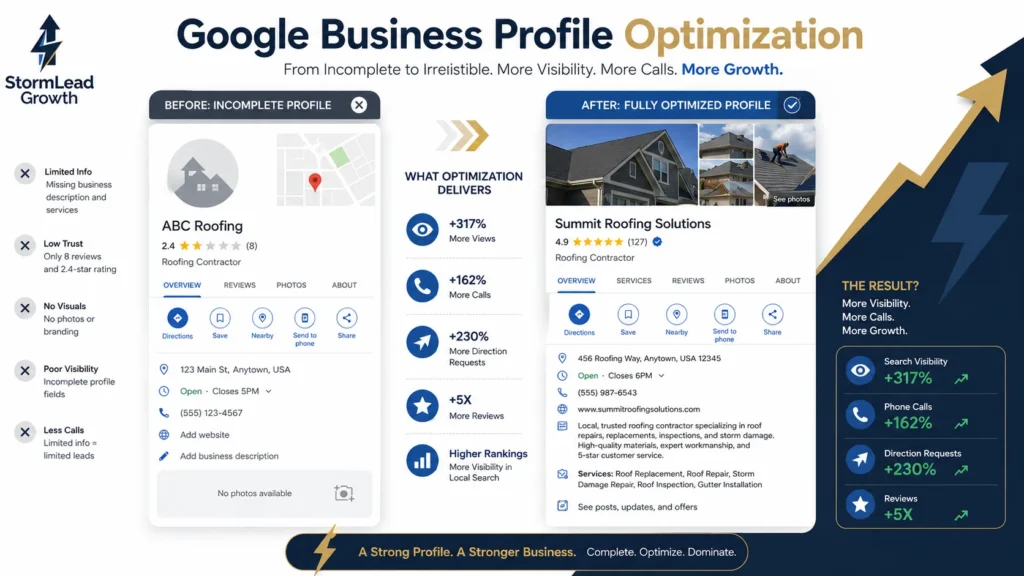
Your Google Business Profile (GBP) is the foundation of Google Maps ranking for roofers. If your profile is incomplete, outdated, or unverified, you won’t rank.
If you haven’t claimed your profile yet, go to business.google.com and search for your business. Claim it and verify it — Google will send you a postcard, call you, or verify by email depending on your situation.
Once claimed, fill out every single field. Your business name should match your legal business name exactly. Your address should be your real business address. Your phone number should be a local number, not a toll-free number. Your business hours should be accurate.
For the business category, select “Roofing Contractor” as your primary category. You can add secondary categories like “Roof Repair Service,” “Commercial Roofing Contractor,” or “Gutter Cleaning Service” if you offer those. But keep your primary category focused on roofing.
Write a business description that naturally mentions your services and the areas you serve. Something like “We provide roof replacement, storm damage repair, roof inspections, and emergency roofing services for homeowners in [your city] and surrounding areas.” Keep it real. Don’t stuff it with keywords.
Step 2: Add Your Service Areas
If you serve customers at their location (which most roofers do), set up your service areas properly. You can list specific cities, counties, or zip codes.
Add every city and neighborhood where you actually do work. If you serve a 30-mile radius around your office, list the individual cities within that radius. Google uses this information to decide when to show your business to homeowners in those areas.
Don’t list areas you don’t actually serve. If someone in a distant city calls and you can’t take the job, that’s a wasted lead and a potential bad review.
Step 3: Get Reviews — More and Better
Reviews are the most important factor in roofing Map Pack ranking after proximity. The more positive reviews you have, the more often Google shows your business.
Aim for a consistent flow of reviews rather than a big burst followed by silence. Getting 2 to 4 reviews per month is better than getting 20 in one week and then nothing for six months. Google looks at recency too — recent reviews carry more weight than old ones.
After every completed job, send the homeowner a text with a direct link to your Google review page. Keep the message simple: “Thanks for choosing us for your roof. If you have a minute, a Google review helps us a lot.” Include the link. Make it one tap.
Respond to every review within 24 hours. Thank five-star reviewers by name and mention the specific work you did. For negative reviews, stay professional, acknowledge the concern, and offer to resolve it. How you respond to negative reviews tells future customers more about your business than the negative review itself.
Step 4: Add Photos Regularly
Google Business Profiles with more photos get more engagement. For a roofing company, the best photos are:
Before-and-after shots of completed jobs. These show homeowners what your work actually looks like and build confidence that you do quality work.
Photos of your crew on the job. Real people, real trucks, real roofs. These feel authentic and help homeowners connect with your company.
Photos of your office, trucks, and equipment. These show that you’re a real, established business.
Upload at least 3 to 5 new photos per month. Don’t use stock photos — Google’s systems can detect them, and homeowners can tell. Use real photos from real jobs.
Step 5: Post Weekly Updates on Your GBP
Google Business Profile has a “Posts” feature that lets you share updates, offers, and news. Most roofers ignore this completely, which is an easy win for you.
Post once a week. It doesn’t need to be long. A few sentences with a photo works. Some ideas:
- A recent job you completed (“Just finished a full roof replacement in [neighborhood]. The homeowner had storm damage from last month’s hail.”)
- A seasonal tip (“Spring is a great time for a roof inspection. Small problems caught now save thousands later.”)
- A service highlight (“We now offer free drone inspections for storm damage assessment.”)
These posts show up on your profile, signal to Google that your business is active, and give homeowners more reasons to trust and call you.
Step 6: Build Consistent Citations
Citations are mentions of your business name, address, and phone number on other websites — directories, social platforms, industry sites. Google uses citations to verify that your business is real and that the information is accurate.
Your business name, address, and phone number (called NAP) need to be exactly the same everywhere. If your GBP says “ABC Roofing LLC” but Yelp says “ABC Roofing” and Angi says “A.B.C. Roofing LLC,” that inconsistency confuses Google and can hurt your rankings.
Start with the big ones: Yelp, BBB, Angi, HomeAdvisor, Facebook, Apple Maps, Bing Places. Then add industry-specific directories. Make sure every listing matches your GBP exactly.
If you’ve changed your address or phone number in the past, old listings with outdated information might still be out there. Find them and update them. This cleanup alone can improve your Map Pack position.
Step 7: Get Local Backlinks
Backlinks (links from other websites to yours) matter for Map Pack rankings too. They signal to Google that other people trust your business enough to link to it.
For a roofing company, the best local backlinks come from local business associations, chambers of commerce, roofing material supplier websites, local news mentions, and sponsorships of local events or teams.
You don’t need hundreds. Even 10 to 20 quality local links can make a noticeable difference compared to a competitor who has none.
Step 8: Make Sure Your Website Supports Your GBP
Your Google Business Profile links to your website, and Google looks at your website to understand more about your business. If your website doesn’t mention the cities you serve, the services you offer, or basic information about your company, it weakens your Map Pack presence.
Your website should have a page for each core service you offer and ideally a page for each major city or area you serve. These pages should include the city name, the services you provide there, and a way for visitors to contact you.
This is where local SEO on your website connects to your Map Pack rankings. They work together — your website feeds information to Google that strengthens your GBP listing.
At StormLead Growth, we build local SEO systems that connect your website, Google Business Profile, and citations into one coordinated system. See how our local SEO and AI visibility service for roofing contractors works.
How Long Does It Take to Rank in the Map Pack?
If you’re starting from scratch with a new or poorly optimized Google Business Profile, expect 2 to 4 months before you start showing up consistently in the Map Pack for your primary city. For surrounding cities in your service area, it can take 4 to 6 months.
The speed depends mostly on how competitive your market is and how many reviews you can build in that time. A roofer in a small town with few competitors will rank faster than one in a large metro area with dozens of competitors.
The work compounds over time. Each new review, each new citation, each new photo, each new post adds a small signal that pushes you higher. After 6 months of consistent work, you’ll be in a much stronger position than where you started.
The Bigger Picture
Google Maps SEO for roofers doesn’t work in isolation. Your GBP, your website, your reviews, your citations, and your content all connect. Improving one helps the others.
The roofing companies that consistently show up in the Map Pack aren’t doing anything magical. They’re doing the basics consistently — keeping their profile complete, building reviews every month, posting updates, and making sure their website supports it all.
At StormLead Growth, we handle all of this for roofing contractors so they can focus on roofing. From GBP optimization to citations to monthly reporting, we build the local SEO foundation that keeps your phone ringing.
Ready to show up in the Map Pack? Check out our local SEO service for roofing contractors and get a free visibility scorecard within 24 hours.
✦ Want to know where you rank in the Map Pack vs your top 3 competitors? StormLead Growth offers a free Map Pack scorecard — delivered within 24 hours.
Also Read – How to Optimize Google Local Service Ads for Roofers (Step by Step)
Google Ads vs Local Service Ads for Roofers: Which One Gets More Calls?