You’ve probably heard someone say “you need SEO” without explaining what that actually means for a roofing company. And when you Google “SEO for roofers” you get pages full of marketing jargon that doesn’t help at all.
So here’s the plain version. Local SEO for roofers means making your roofing company show up when homeowners in your area search Google for roofing services. That’s it. When someone types “roofer near me” or “roof repair in [your city],” local SEO is what determines whether your company shows up or whether your competitor does.
This guide covers everything you need to know in simple language. No jargon. No fluff. Just what to do and why.
What Is Local SEO and Why Should Roofers Care?
SEO stands for search engine optimization. It means making your website and online presence easier for Google to understand and rank.
Local SEO is the version of SEO that focuses on your local area. Instead of trying to rank everywhere in the country, you’re trying to rank in the cities and neighborhoods where your crews actually work.
Why does it matter? Because homeowners find roofers on Google. When their roof leaks, when they get hail damage, when they need an inspection — they go to Google first. If your company doesn’t show up, they call whoever does.
Unlike paid ads, local SEO produces results that don’t cost you per click or per lead. Once you rank, the calls come in without a monthly ad spend. That doesn’t mean it’s free — it takes time and effort to build. But once it’s built, it keeps working.
The Two Places You Need to Show Up
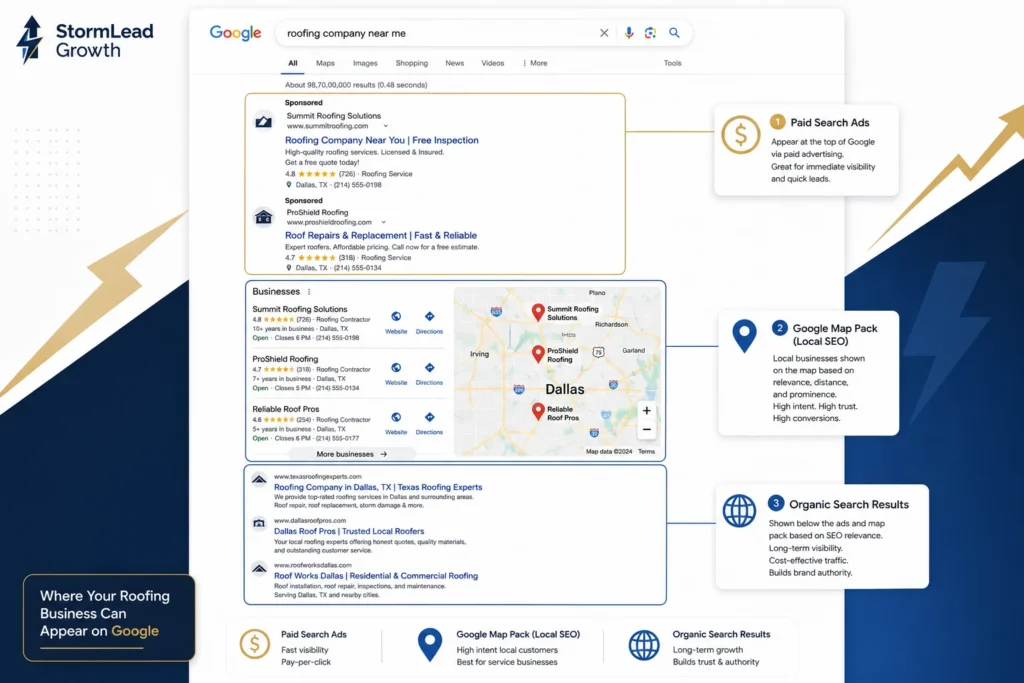
When a homeowner searches for a roofer on Google, there are two main sections where local businesses appear:
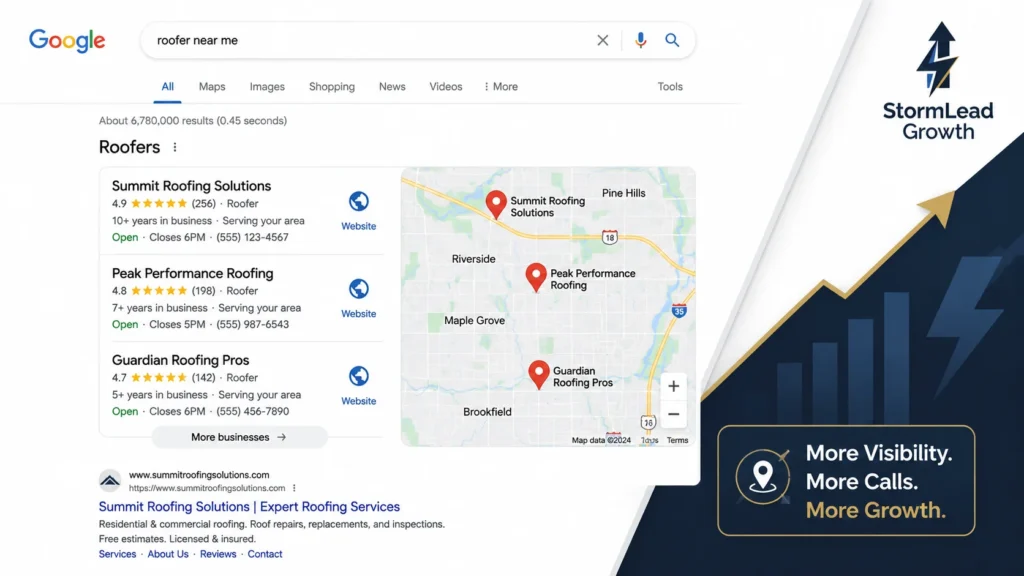
The Map Pack. This is the box with three local businesses shown on a map. It appears near the top of the search results. It shows your business name, star rating, phone number, and hours. Homeowners can call you directly from here without visiting your website.
Organic results. These are the regular website listings below the Map Pack. Your website’s pages — homepage, service pages, blog posts — can show up here when they’re relevant to what the homeowner searched.
To get the best results, you want to show up in both. The Map Pack is driven mainly by your Google Business Profile. The organic results are driven mainly by your website. Both need to be optimized.
Part 1: Your Google Business Profile
Your Google Business Profile (GBP) is the most important piece of roofing local SEO. It’s the listing that controls how you show up on Google Maps and in the Map Pack.
Claim and verify it. If you haven’t already, go to business.google.com and claim your profile. Google will verify your business through a postcard, phone call, or email.
Fill out everything. Don’t leave any field empty. Your business name should be your exact legal name — don’t add keywords to it (like “ABC Roofing — Best Roofer in Dallas”). Your address, phone number, and hours need to be accurate.
Pick the right categories. Your primary category should be “Roofing Contractor.” Add secondary categories for other services you offer, like “Roof Repair Service” or “Commercial Roofing Contractor.”
Write a good description. Mention your services and the areas you serve naturally. “We provide roof replacement, repair, storm damage restoration, and inspections for homeowners in Austin, Round Rock, Cedar Park, and surrounding areas.”
Add photos every month. Real photos of your completed jobs, your crew, your trucks. Google favors profiles with recent, real images.
Post weekly updates. Use the Posts feature to share job completions, seasonal tips, or promotions. This signals to Google that your business is active.
Build reviews. More on this below — reviews are the biggest ranking factor after proximity.
Part 2: Your Website
Your Google Business Profile links to your website. Google uses your website to learn more about your business — what services you offer, where you work, and whether your site is trustworthy enough to show to homeowners.
Homepage. Your homepage should clearly say what you do and where you do it. “Roofing contractor serving [city] and surrounding areas” in a prominent heading. Include your phone number, a contact form, and a brief overview of your services.
Service pages. Create a separate page for each main service you offer. One page for roof replacement. One for roof repair. One for storm damage. One for inspections. One for commercial roofing — whatever services make sense for your business.
Each service page should explain the service, who it’s for, and how to contact you. Use the service name in the page title and heading. Write at least 500 to 1,000 words of useful content — enough for Google to understand what the page is about.
City pages. If you serve multiple cities, create a page for each one. “Roofing Services in Round Rock” with content specific to that area — mention neighborhoods, local conditions, common roof types in that area. Don’t just copy the same text and swap the city name. Google can tell, and it won’t rank duplicate content.
Page titles and meta descriptions. Every page on your website has a title tag (what shows in the browser tab and in Google search results) and a meta description (the short summary below the title in search results). These should include your main keyword for that page and be written to make someone want to click.
For example:
- Title: “Roof Repair in Austin TX — Fast, Reliable Service | Your Company Name”
- Meta description: “Need roof repair in Austin? We fix leaks, storm damage, and aging roofs. Licensed, insured, and locally owned. Call for a free estimate.”
Mobile-friendly design. More than 70% of homeowners searching for roofers are on their phone. If your website is slow to load, hard to read on a small screen, or doesn’t have a tap-to-call button, you’re losing those visitors.
Schema markup. This is a bit of code added to your website that helps Google understand your business details — name, address, phone number, services, service area, reviews. You don’t need to understand the code yourself. Your web developer should handle it. But ask them to add LocalBusiness and RoofingContractor schema to your site.
At StormLead Growth, we build roofing websites with local SEO architecture built into every page — service pages, city pages, schema markup, and everything described above. Learn more about our local SEO and AI visibility service for roofers.
Part 3: Reviews
Reviews are one of the top three factors in local SEO rankings. A roofing company with 100 reviews and a 4.7-star rating will almost always outrank one with 15 reviews and a 4.9-star rating. Volume matters.
Ask after every job. Make it a habit. When the job is done and the homeowner is happy, send them a text with a direct link to your Google review page. Not a link to your website. Not a link to Yelp. A direct Google review link.
Make it easy. One tap on their phone to leave a review. If they have to search for your business on Google and figure out how to leave a review, most people won’t bother.
Respond to every review. Thank positive reviewers by name. Address negative reviews professionally. Your responses are public — future customers read them.
Be consistent. Getting reviews isn’t a one-time project. Build it into your process. The roofing companies that rank well in local search have a steady stream of new reviews coming in every month.
Part 4: Citations
Citations are listings of your business on other websites — Yelp, BBB, Angi, HomeAdvisor, Facebook, Apple Maps, Bing Places, and dozens of other directories.
Google uses citations to verify that your business is real and that your information is consistent. If your name, address, or phone number is different on different sites, it confuses Google and can hurt your rankings.
Go through the major directories and make sure your information is identical everywhere. Same business name, same address format, same phone number. If you moved offices or changed your phone number, update every listing.
This is boring work, but it matters. Inconsistent citations are one of the most common reasons roofing companies don’t rank as well as they should.
Part 5: Backlinks
Backlinks are links from other websites to your website. When another site links to you, Google sees it as a vote of confidence — it means someone else thinks your site is worth pointing people to.
For a local SEO for roofing companies strategy, the best backlinks come from local sources: your local chamber of commerce, local business associations, roofing suppliers, local news sites, and community organizations.
You don’t need hundreds of backlinks. Even 10 to 20 from real, relevant local websites can make a significant difference in your rankings.
Some practical ways to get backlinks: join your local chamber of commerce (they usually link to member businesses), sponsor a local youth sports team or community event, get listed on your roofing material supplier’s website, and reach out to local bloggers or news sites when you do something newsworthy (a big community project, a charity roof, storm response work).
Part 6: Content
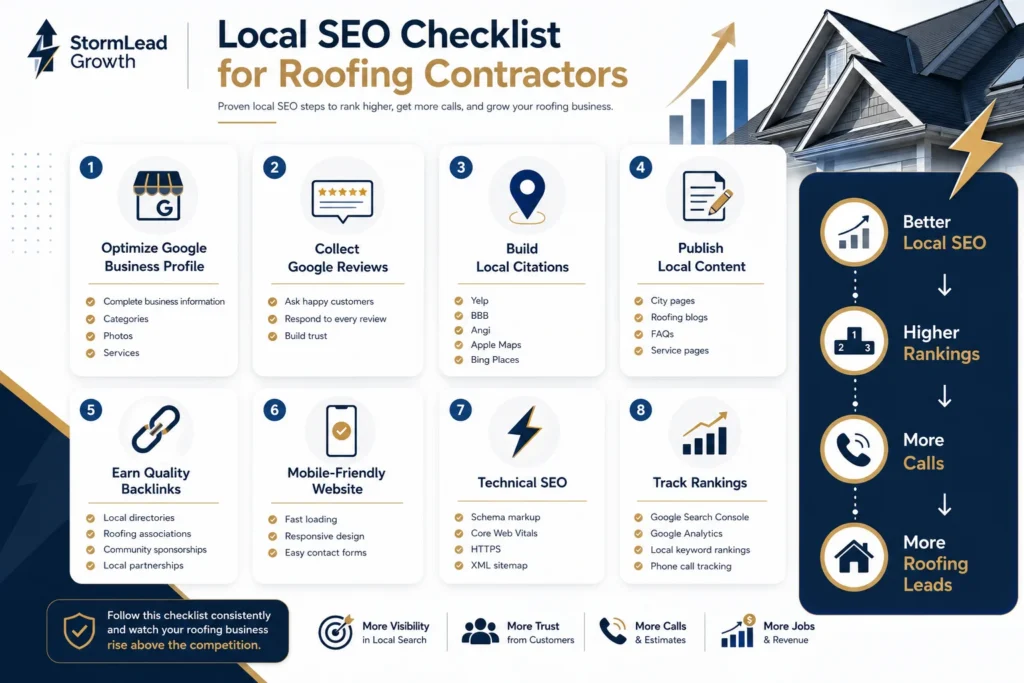
Having a blog on your roofing website helps your local SEO in two ways. First, each blog post gives Google another page to rank — which means more chances to show up in search results. Second, blog posts help establish your website as an authority on roofing topics, which makes Google more likely to rank your service pages too.
You don’t need to be a great writer. Just answer questions that homeowners actually ask:
- “How much does a new roof cost in [city]?”
- “How to tell if your roof has storm damage”
- “How long does a roof replacement take?”
- “Best roofing materials for [your climate]”
Write one post per week if you can. Even two per month is enough to start seeing results over time.
Each blog post should link to the relevant service page on your website. A post about storm damage should link to your storm damage repair service page. This internal linking helps Google understand the structure of your site and passes ranking power from the blog posts to your service pages.
How Long Does Local SEO Take?
This is the question every roofer asks, and the honest answer is: it takes months, not days.
If you’re starting with a new website and no Google Business Profile optimization, expect 3 to 6 months before you start seeing consistent rankings in the Map Pack and organic results for your main city. For surrounding cities, add another 1 to 3 months.
The speed depends on your competition (a small town is faster than a major metro), how many reviews you can build, how much content you publish, and how many quality backlinks you earn.
The results compound over time. The first few months feel slow. Then things start moving. By month 6, if you’ve been consistent, you’ll look back and see real progress.
Local SEO vs Paid Ads: Do You Need Both?
Local SEO for roofing contractors builds long-term visibility that doesn’t stop when you stop paying. But it takes time to build.
Paid ads (Google Ads and Local Service Ads) give you leads immediately. But they stop the moment you pause your budget.
The best approach is running paid ads for immediate lead flow while building local SEO in the background. Over time, as your organic rankings grow, you can reduce ad spend while keeping your lead volume steady.
That’s how roofing companies build marketing systems that last.
Want us to build this for you? StormLead Growth provides local SEO with AI search visibility for roofing contractors — from Google Maps optimization to content strategy to monthly reporting. Get a free visibility scorecard within 24 hours.
Start With One Thing
If this list feels overwhelming, pick one thing and start there. The highest-impact single action is optimizing your Google Business Profile. It’s free, it’s within your control, and it’s the foundation everything else builds on.
Once that’s done, start asking for reviews after every job. Then look at your website and make sure it has proper service pages and city pages. Then start publishing a blog post or two each month.
Local SEO is not a one-time project. It’s an ongoing process. But it’s the most reliable way for a roofing company to build a steady pipeline of calls that doesn’t depend on ads, referrals, or storm season.
✦ Don’t want to do all this yourself? StormLead Growth handles local SEO for roofing contractors — from GBP optimization to content to monthly reporting. Here’s how we work.
- “For a deep dive on Google Maps specifically, read our Google Maps SEO for Roofers guide.” → https://stormleadgrowth.com/blog/google-maps-seo-roofers/
- “Want to understand SEO beyond just local? Read our broader Roofing SEO guide.” → https://stormleadgrowth.com/blog/roofing-seo-how-it-works/